FREE CAPACITY GAP AUDIT
When the System Is Missing Capacity, Someone Absorbs the Gap
Schools don't always have the option to add another teacher, hire another specialist, or create a new program. But that doesn't mean every capacity problem has to become a teacher problem.
The free Capacity Gap Audit helps you identify where recurring instructional, behavioral, service, or workload problems are being absorbed by individual people and determine what kind of system change might reduce that load.
Instead of immediately asking, What should the teacher do differently? the audit helps you ask a better question:
What does this situation require that the system is not reliably providing?
You Know This Pattern
A teacher gives up planning time to cover a recurring problem. A special education teacher gets pulled from services because they're the person who can handle the crisis. An administrator responds to the same issue over and over. Everyone keeps making reasonable decisions to get through the day.
And the school keeps functioning.
That's exactly why the capacity gap can be hard to see.
The missing capacity hasn't disappeared. Someone is compensating for it.
Before adding another intervention, training, expectation, or reminder, the Capacity Gap Audit helps you make that invisible work visible and figure out whether the real problem is instructional, structural, or procedural.
What the Audit Walks You Through
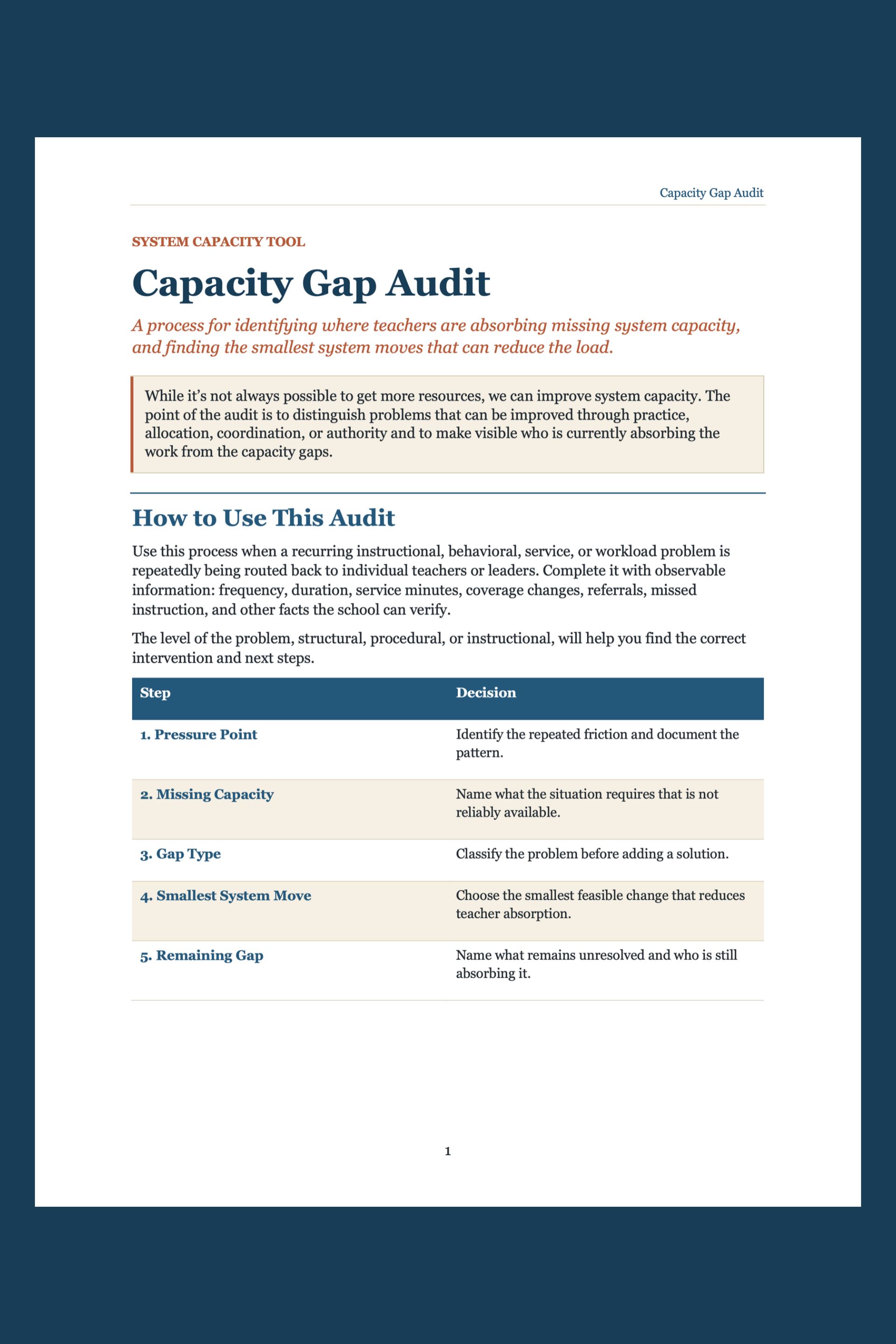
Five steps designed to move you from a recurring problem to a realistic system response:
Identify the pressure point: Find the repeated friction and document the pattern using information you can actually observe.
Name the missing capacity: Determine what the situation requires that isn't reliably available—and who is currently making up the difference.
Classify the gap: Distinguish between practice, allocation, coordination, authority, and true capacity gaps so you respond at the right level.
Choose the smallest system move: Identify one feasible change that can reduce the amount of missing capacity being absorbed by individual staff members.
Name the remaining gap: Be explicit about what the change won't solve, who will still carry the remaining load, and what expectations may need to change because of it.
You'll finish with a one-page Capacity Gap Decision Summary and a review point so you can see whether the system move actually reduced the pressure.
About Cathy
I'm Dr. Cathy White, and I've spent more than twenty-five years in education as a teacher, school leader, consultant, researcher, and special education administrator.
Again and again, I've watched schools solve system problems by relying on capable people to work harder, stay later, fill the gaps, and somehow keep everything running. It works...until it doesn't.
My work focuses on helping school leaders look underneath recurring problems, identify the systems producing them, and make practical changes that reduce unnecessary friction for the people doing the work.
The Capacity Gap Audit comes directly from that work.